News | 22/05/2026
Infection research

Using data against ticks: New ways to predict disease risks

MONID HABITRACK uses drones and artificial intelligence to research the spread of tick-borne diseases in the districts of Amberg-Sulzbach and Schwandorf
With the onset of early summer, tick activity increases in meadows, forests, and gardens. The risk of contracting tick-borne encephalitis (TBE) or Lyme disease after a tick bite depends heavily on where you live. According to the Robert Koch Institute, the districts of Amberg-Sulzbach and Schwandorf in the Upper Palatinate are among the areas with the highest TBE incidence in Germany. However, such risk areas have so far mainly been identified retrospectively on the basis of reported cases.
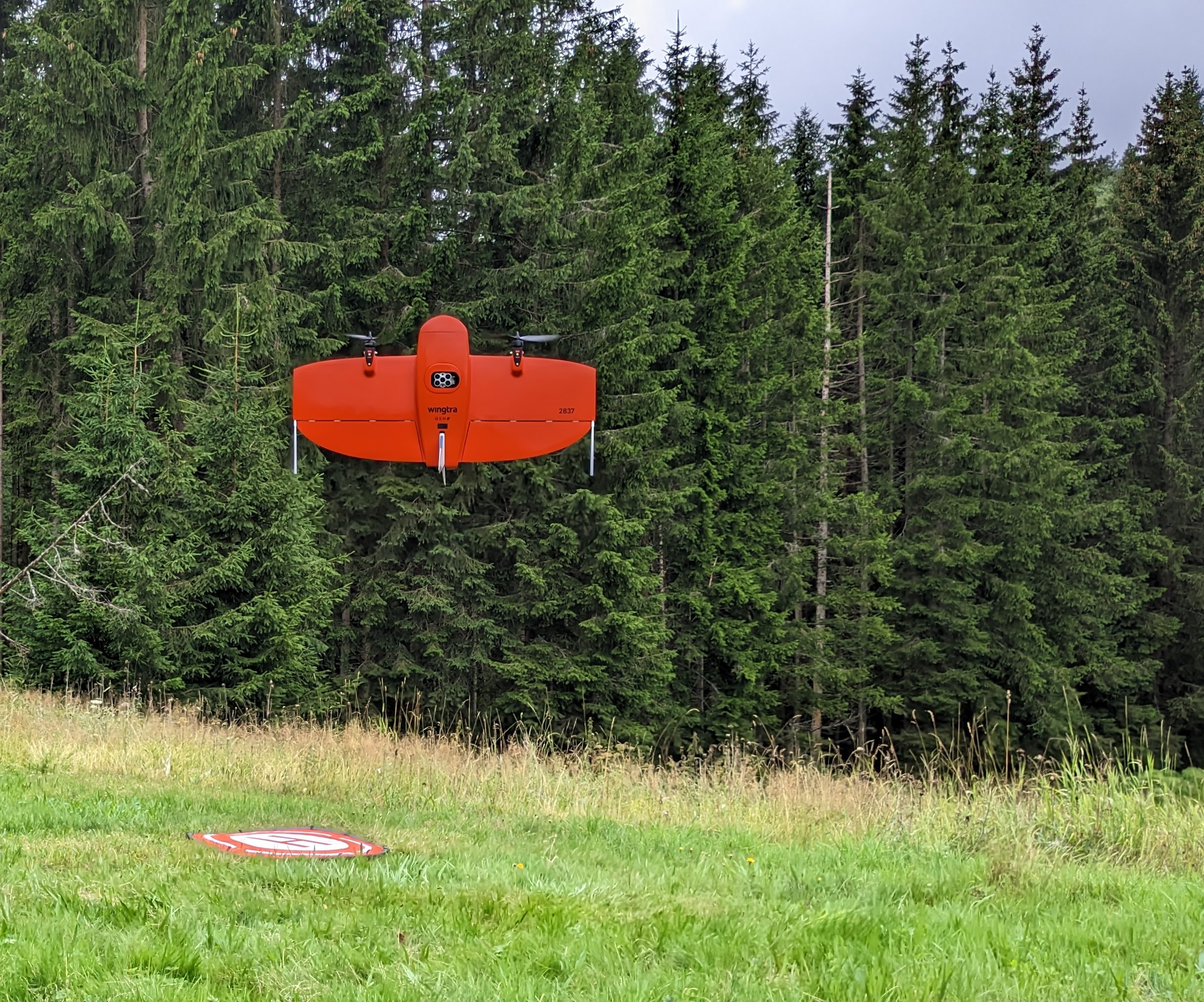
A Wingtra drone taking pictures in the MONID HABITRACK project

This is precisely where the MONID HABITRACK project (Habitat Prediction and Surveillance of Tick-borne Diseases using Modeling and Imaging Technology), which was launched at the beginning of 2026, comes in. Coordinated by the Data Science Unit (Head: Prof. Noemi Castelletti) at the Institute of Infectious Diseases and Tropical Medicine at LMU University Hospital Munich, an interdisciplinary team* from the fields of mathematical modeling, epidemiology, virology, entomology, and remote sensing is using innovative data and methods. The aim of the project, funded with 1.8 million euros by the German Federal Ministry of Research, Technology and Space (BMFTR), is to predict the risk of infectious diseases transmitted by vectors such as ticks in the model region more accurately.

Data platform for early detection and risk analysis

The researchers are building a central platform that integrates weather, case, drone, and tick data. With the help of drone images, machine learning, and AI-supported analysis, this multi-layered data is linked and incorporated into models for predicting infection risks. Drone imagery menable the characterization of TBE and Borrelia foci and thus provide indicators of possible areas with natural transmission. In addition, virological, bacteriological, entomological, weather, and climate data are incorporated in order to better map environmental conditions and the spread of TBE and Lyme disease.

The researchers also plan to conduct a serological study in the districts of Amberg-Sulzbach and Schwandorf as the project progresses. This study will examine how many of the participants have already formed antibodies against TBE or Lyme disease without having been detected previously.

If you are interested in voluntary participation, you can contact the study team by e-mail (habitrack@med.uni-muenchen.de) without obligation and you will be contacted as soon as the study starts.

The results of MONID HABITRACK are expected to help to better assess infection risks, detect outbreaks earlier, and improve predictions of infection waves and hotspots. In this way, preventive measures - medical and non-medical - can be evaluated and regional disease control strategies developed. At the same time, the project strengthens pandemic preparedness by enabling ealier responses to emerging outbreaks of vector-borne diseases at an early stage.

Wide-ranging expertise in the MONID research network

In addition to the Munich Tropical Institute, MONID HABITRACK brings together leading experts* based in Bavaria, from the German Consiliary Laboratory for TBE (DKF) Munich, the Fraunhofer Institute for Translational Medicine and Pharmacology ITMP, Immunology, Infection and Pandemic Research IIP, Penzberg/Munich, the Chair of Global Urbanization and Remote Sensing, Earth Observation Research Cluster at the Institute of Geography and Geology at Julius-Maximilians-Universität Würzburg (JMU) and the Bavarian State Office for Health and Food Safety (LGL) with the National Reference Centre for Borrelia.

The MONID HABITRACK project is funded by the Federal Ministry of Research, Technology and Space (BMFTR) under grant number 031L0326A and is also part of the BMFTR-funded research network MONID (Modeling Network for Major Infectious Diseases).

Scientific contact

Prof. Noemi Castelletti

Head of Data Science Unit, Institute of Infectious Diseases and Tropical Medicine, LMU University Hospital Munich / University Medical Center of Johannes Gutenberg University Mainz, Head of Biometry Department

Press contact

Judith Eckstein

Institute of Infectious Diseases and Tropical Medicine, LMU University Hospital Munich

Originally translated with DeepL