Peter Falkai receives the World Psychiatric Association’s (WPA) most prestigious award, the Jean Delay Prize
The director of the Department of Psychiatry and Psychotherapy at the LMU University Hospital and director of the Max Planck Institute of Psychiatry is being honored for his decades of outstanding achievements in the field of psychiatry. Falkai’s research focuses on psychotic disorders - in particular, he investigates the neurobiological basis of cognitive deficits in schizophrenia and is currently working on the development of new medications in this field, always with the patients in mind. The award was presented to him on September 26th at the WPA Congress in Stockholm.
LMU Klinikum
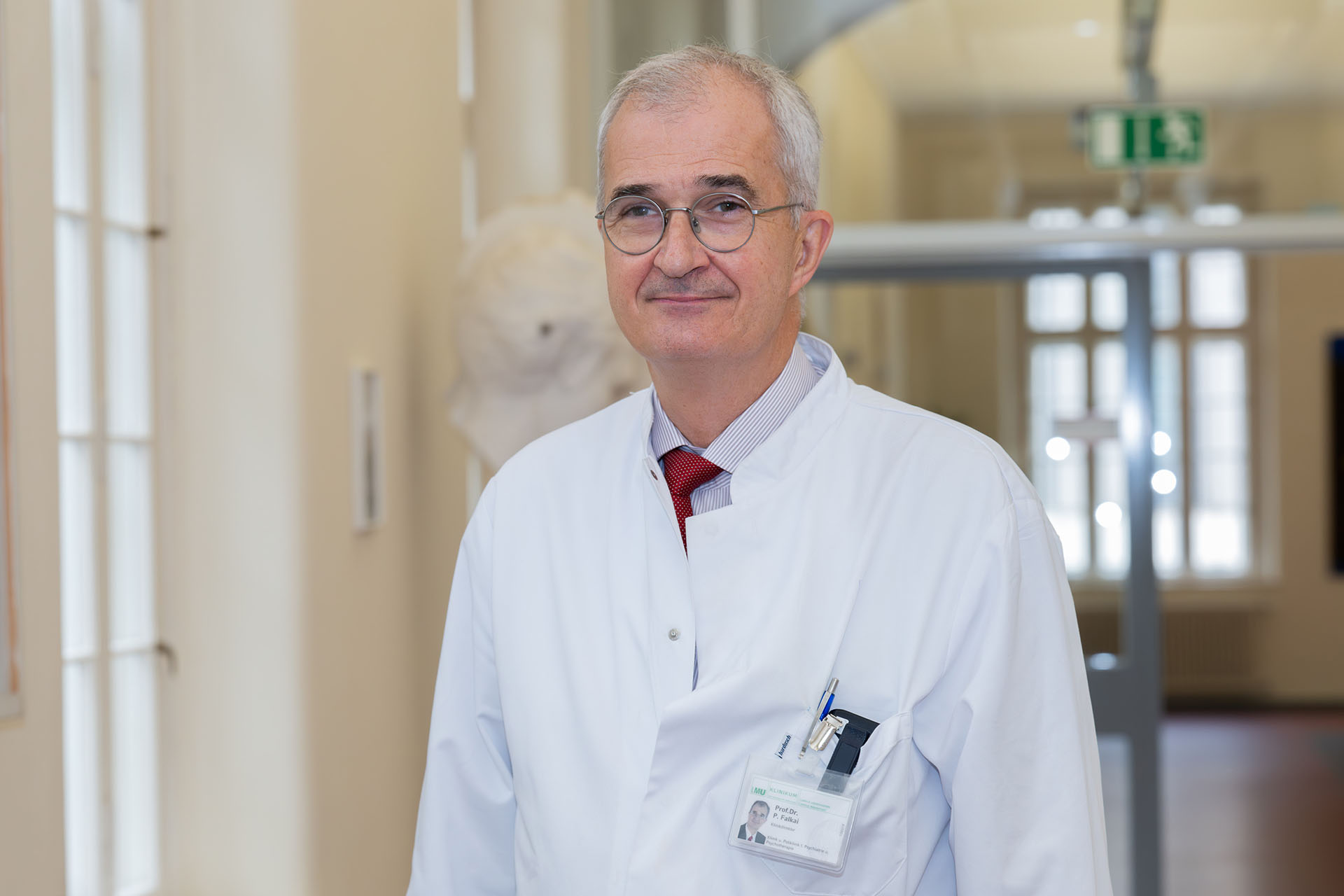
Prof. Dr. med. Peter Falkai, director of the Department of Psychiatry and Psychotherapy at the LMU University Hospital Munich and director of the Max Planck Institute of Psychiatry
“I was certainly surprised when I heard about this honor,” says Peter Falkai. After all, only ten psychiatrists worldwide have received the Jean Delay Prize, named after an influential figure in modern psychiatry. Accordingly, the scientific contributions of the awardees —whether focusing on biological, psychological, or social aspects, or on the important combination thereof—are of the highest caliber. But it likely wasn’t too difficult for the international jury of experts, who selected the winner, to settle on the name Peter Falkai.
What the psychiatrist has accomplished over the past decades represents medical research at its best. His focus is on those patients who, despite treatment in accordance with medical guidelines, have a poor prognosis—largely due to their pronounced cognitive deficits. This condition, historically described as “dementia praecox,” results in those affected being unable to complete even simple everyday tasks. “The central problem is impaired cognition,” explains Falkai. “And to this day, we still don’t know enough about where it comes from or how to treat it effectively.”
A disruption in connections
A turning point in his research was the realization that the brains of people with schizophrenia appear largely normal anatomically. Falkai’s conclusion: “The disorder lies not in the nerve cells themselves, but in their connectivity”—that is, the connections and the brain’s ability to adapt and regenerate. This plasticity is particularly impaired in the hippocampus, a region that is crucial for memory and learning ability.
To therapeutically influence this plasticity, Falkai initiated a series of “exercise studies” about 20 years ago. The results are remarkable: Regular ergometer training—three times a week for three months—not only improves symptoms and attention but also leads to an increase in the volume of the hippocampus. About 40 to 50 percent of patients benefit significantly, and some even achieve complete, sustained remission. “Intense exercise,” according to Falkai, “acts like a growth spurt for the brain.”
A disruption in myelin maturation
The question of the underlying mechanism led to genetic analyses and the identification of impaired myelin maturation. The myelin sheath surrounding nerve fibers, produced by specific cells (oligodendrocytes), is essential for rapid signal transmission in the brain. “In some of those affected, these cells do not mature properly—a process that can be normalized through exercise,” says the Jean Delay Prize winner.
Another breakthrough came with the use of the biomarker “neurofilament light chain” (NFL) in the blood, which had previously been described for schizophrenia by the research group led by Johann Steiner (Magdeburg). Elevated NFL levels seem to indicate reversible myelin damage. About a quarter of patients show such elevated levels; it is precisely this group that benefits most from interventions that enhance plasticity. This reveals, for the first time, a biologically defined subgroup for targeted treatment.
In addition to exercise, Falkai’s team identified two medications that promote myelin maturation: Clemastine, an antiallergic agent, and quetiapine, an established antipsychotic. “Both show clear effects on normalizing oligodendrocyte maturation in initial studies”, says Falkai. A prospective clinical trial will now determine whether patients with high NFL levels benefit particularly strongly from quetiapine.
A disturbance in neural balance
For the remaining approximately 50 percent of those affected, Falkai suspects an additional disturbance in the balance between excitation and inhibition of nerve cells. Spironolactone—a long-established blood pressure-lowering drug that influences neural balance processes—could represent a new therapeutic approach here.
A corresponding study is in the works. Peter Falkai has thus described a three-part model of schizophrenia: First, a group with a good prognosis that requires little intervention; second, a clearly identifiable subgroup with impaired myelin plasticity that responds to exercise and quetiapine; and third, a larger group with additional neuronal imbalances for which new therapeutic approaches are being developed.
In addition to research, the Jean Delay Prize winner emphasizes the need to structurally integrate exercise therapy into care—both in inpatient and outpatient settings. “We know that intensive exercise works. Now we have to find ways to offer it on a regular basis.”
Nursing with heart and expertise: Experience the Nursing Careers Day at LMU Hospital on June 27, 2025 - a day full of inspiring insights into the demanding and holistic everyday life of nursing. Meet experts, discover a wide range of career opportunities and receive exciting information on jobs, training and further education. Come along, exchange ideas with colleagues and let yourself be inspired by nursing science in practice - without obligation and without registration.