press releases | 05/03/2026

New perspective for the treatment of autoimmune diseases

A team at LMU Hospital achieves breakthrough in therapy-resistant immune thrombocytopenia and antiphospholipid syndrome
When two rare autoimmune diseases - immune thrombocytopenia (ITP) and antiphospholipid syndrome (APS) - combine in one patient, this can lead to a life-threatening spiral of severe bleeding and blood clots. An interdisciplinary team from the Department of Medicine III at LMU University Hospital Munich has now been able to show for the first time that a new form of immunotherapy using so-called bispecific antibodies can specifically switch off the underlying autoimmune reaction. The results of this groundbreaking treatment have now been published in the renowned "New England Journal of Medicine".
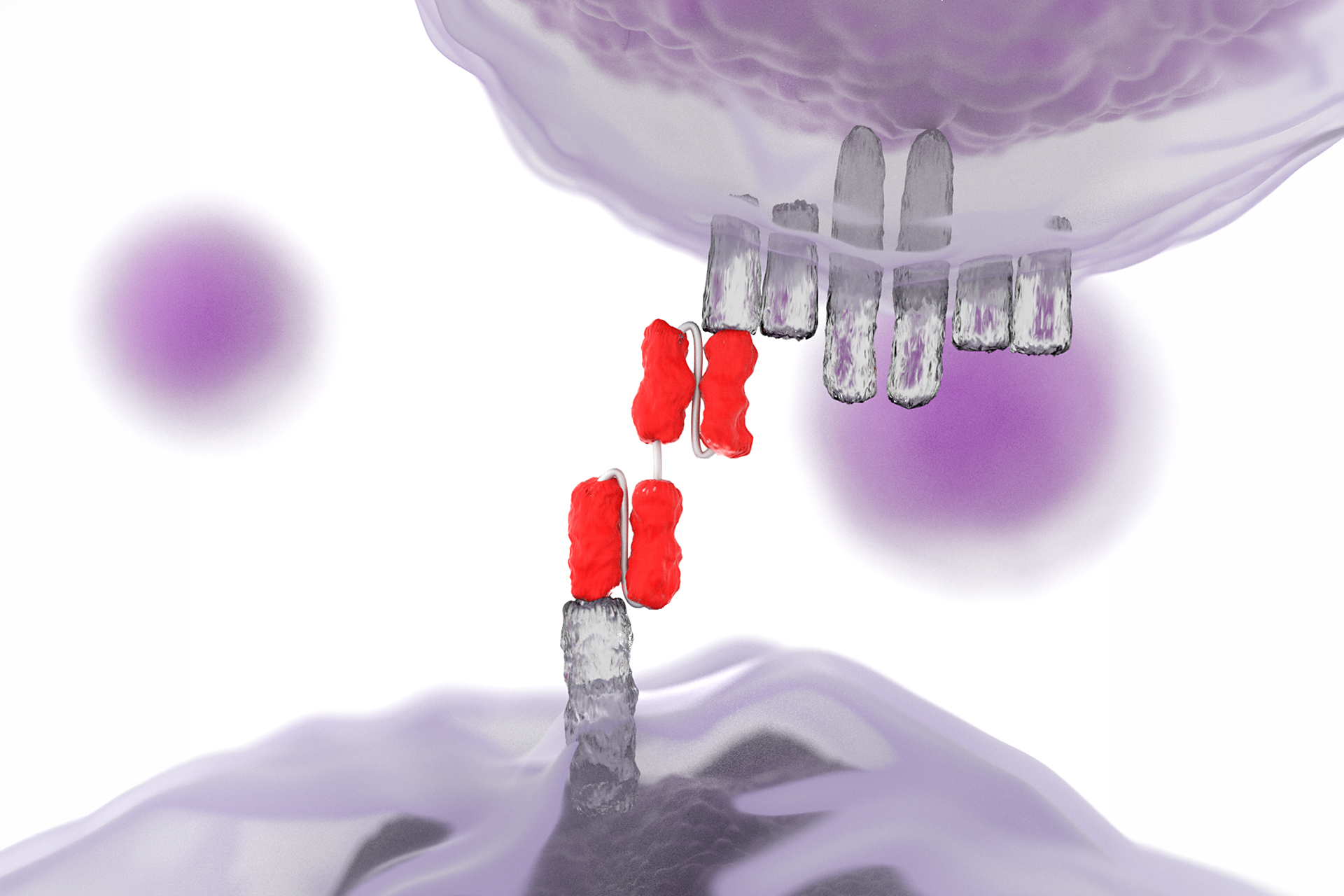
A bispecific antibody (blinatumomab, red) links a T cell (top) via CD3 to a CD19-positive B cell (bottom). This spatial coupling leads to activation of the T cell and targeted destruction of the target cell.

In the case of immune thrombocytopenia, the immune system is directed against the patient's own blood platelets, resulting in spontaneous bleeding. Antiphospholipid syndrome, on the other hand, leads to pathological activation of coagulation and life-threatening thromboses. If the two diseases come together, a dangerous contradiction arises: the body is at risk of bleeding to death and forming blood clots at the same time. "Such patients present us with extreme medical challenges," explains Prof. Dr. Karsten Spiekermann, hemostaseologist at LMU University Hospital Munich.

Novel immunotherapy activates the body's own T cells

In recent years, a special form of immunotherapy - known as CAR-T cell therapy - has already shown impressive success in autoimmune diseases. However, this therapy is complex, individually produced and requires chemotherapy, which can cause infertility and new cancers.

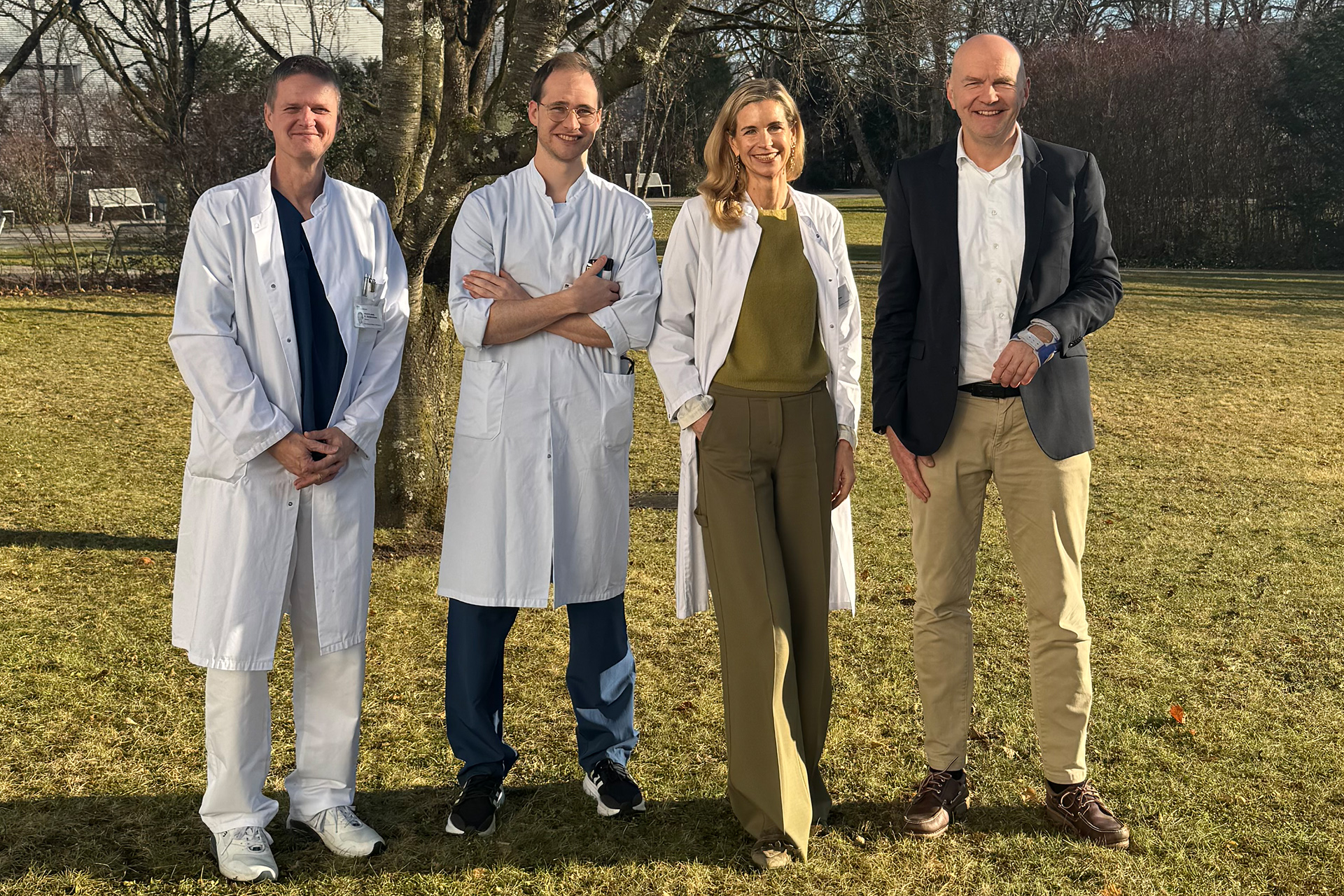
Prof. Dr. Karsten Spiekermann, Dr. Adrian Gottschlich, Prof. Dr. Marion Subklewe und Prof. Dr. Dr. Michael von Bergwelt
From left to right: Prof. Dr. Karsten Spiekermann, Dr. Adrian Gottschlich, Prof. Dr. Marion Subklewe and Prof. Dr. Dr. Michael von Bergwelt

The Munich team led by Prof. Dr. Marion Subklewe, Dr. Adrian Gottschlich, Prof. Dr. Karsten Spiekermann and Prof. Dr. Dr. Michael von Bergwelt used their expertise in T-cell-recruiting immunotherapies to test an alternative, gentler method: the bispecific antibody blinatumomab. "Bispecific antibodies act like a molecular link between T cells and disease-causing B cells", explains Prof. Marion Subklewe, head of the immunotherapy focus area at LMU University Hospital. "This allows us to specifically switch off the cells that produce harmful autoantibodies without the need for chemotherapy."

Disappearance of autoantibodies - stable blood platelets

As part of a compassionate use program, a young patient with therapy-resistant ITP and APS received two cycles of treatment with blinatumomab. Shortly after starting treatment, the blood platelets increased and the previously disease-causing antibodies disappeared completely. "After countless unsuccessful treatment attempts, we were able to taper off the haematopoietic drugs for the first time - but the platelets remained stable," reports Dr. Adrian Gottschlich, first author of the study. "At the same time, the autoantibodies, which were responsible for both the bleeding tendency and the thromboses, disappeared."

Accompanying laboratory analyses, carried out in cooperation with PD Dr. Rainer Kaiser (Department of Medicine I, Cardiology), also showed that the formation of coagulation-promoting blood platelets completely normalized after the therapy.

Significance for the future

Since the treatment, the patient has normal platelet counts and is free of pain, bleeding and thrombosis - and was able to start oral blood-thinning therapy again for the first time in years and avoid daily subcutaneous injections. This means an enormous gain in quality of life and a return to a normal life. "The data show the enormous potential of targeted immunotherapies for autoimmune diseases," emphasizes Prof. Dr. Dr. Michael von Bergwelt. "Bispecific antibodies in particular open up new, safe treatment options - especially for young patients."

Publication

Blinatumomab in Combined Immune Thrombocytopenia and Antiphospholipid Syndrome
Gottschlich A, Bücklein V, El-Marouk V, Kaiser V, Schmid M, Janert TA, Winkelmann M, Ziemann F, Hänel G, Handtke S, Thiele T, Wichmann C, Kobold K, Zugmaier G, Rausch C, Schulze-Koops H, Lindner LH, Spiekermann K#, von Bergwelt-Baildon M & Subklewe M# | The New England Journal of Medicine, 2026

DOI: 10.1056/NEJMc2516228

# these authors contributed equally

Explanation

Immune thrombocytopenia (ITP)

Immune thrombocytopenia (ITP) is a rare autoimmune disease in which the body's own immune system mistakenly attacks and destroys the blood platelets (thrombocytes). Platelets are essential for blood clotting and protection against bleeding.

The immune-mediated breakdown causes the number of platelets in the blood to drop significantly. This can lead to an increased tendency to bleed, which can range from minor skin or mucous membrane bleeding to severe, potentially life-threatening bleeding. The disease can be acute or chronic and affects both children and adults.

Antiphospholipid syndrome (APS)

Antiphospholipid syndrome (APS) is a systemic autoimmune disease in which the body produces autoantibodies against certain components of cell membranes (phospholipids) or proteins bound to them.

These antibodies lead to an increased tendency for the blood to clot, which can result in thrombosis in veins and arteries. APS is also an important cause of pregnancy complications such as repeated miscarriages.

APS occurs in isolation or in conjunction with other autoimmune diseases, in particular systemic lupus erythematosus or the immune thrombocytopenia described above.

All LMU Hospital Press Releases

Contact

Prof. Dr. med. Subklewe, Marion

Head of Cellular Immunotherapy, Senior Physician in Hematology / Oncology, LMU University Hospital

Dr. med. Gottschlich, Adrian

Department of Medicine III, LMU University Hospital Munich

Originally translated with DeepL